Fire department flashlights: essential equipment in dangerous situations
A good fire department flashlight is characterized by a robust design, endurance and luminosity. In addition, reliability is a clear priority because the torch must always work, even in extreme situations. As an important piece of equipment, a fire department flashlight is needed and used in the following situations, among others:
- To rescue people from a burning house or industrial plant.
- In disaster operations, e.g. in the event of flooding.
- For better visibility when extinguishing a fire at night or in dark, smoky rooms.
- To illuminate the scene of an accident or when rescuing injured persons from a vehicle involved in an accident.
- To protect against water contamination, for example if a tank containing a hazardous substance leaks.
The most important requirements for an LED torch for firefighters at a glance:
- Robustness and durability: flashlights must be extremely robust and durable in order to withstand tough operating conditions.
- Brightness and light range: High brightness and light range are important to ensure optimum visibility even in dark environments.
- Battery life: With potentially long hours of use, flashlights must have sufficient battery life or battery power to minimize interruptions during use.
- Waterproofness and dust resistance: As firefighters are often confronted with water and dust, flashlights with a high level of waterproofness and dust resistance are required to ensure reliable operation even in harsh conditions.
- Certified lamps in accordance with ATEX directives: Flashlights that are primarily used in potentially explosive atmospheres, for example in industrial plants, must be explosion-proof.
- Simple operation: Switches must be designed in such a way that they are easy to operate even when wearing gloves.
Fire department flashlight with adjustable light functions
You should be able to easily adjust the light from the flashlight to suit the situation:
- Focus, i.e., concentrate the beam of light on a point in the distance
- Wide beam of light for illuminating the immediate surroundings
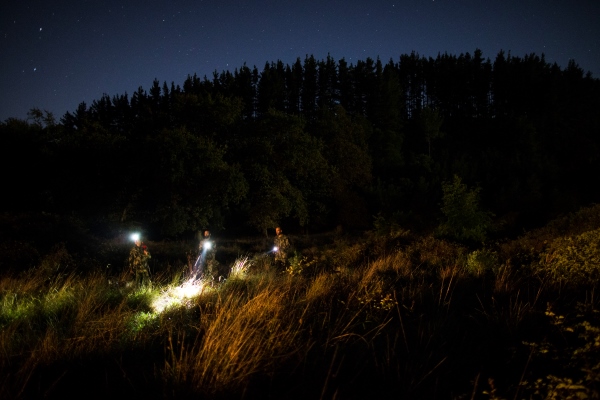
With a focused beam of light, you can search fields, embankments, or riverbanks for missing persons. This also allows you to search buildings or facilities for entrances or damage.
With a wide beam of light, you can illuminate what is directly in front of you: your equipment, technology, injured persons.
Tip: When choosing Ledlenser flashlights for firefighters, look for Advanced Focus System and Flex Sealing Technology, which work together to allow you to switch seamlessly between long-range and close-range lighting without compromising IP protection.
You can set the filter for these technologies in the shop.
Operating fire department flashlights with gloves
The layout and size of the switches on the fire department flashlight must be such that you can operate them even when wearing thick gloves. The following features are helpful for this:
- Switches on the long side and back
- Easily accessible dimming function, as you do not always need full power and can thus increase the battery life.
- Smooth-running focus system for switching between close-range and long-range light
- A memory function so that the flashlight starts immediately in the last mode set after being switched off.
Firefighter flashlight with helmet mount & mounting options
To keep your hands free, your firefighter flashlight should also be attachable to your helmet.
The flashlight can be easily and securely stored in a matching holster for your belt, jacket, or vest.
Fire department flashlight with rechargeable battery or regular battery
During long operations, there is no time to recharge a flashlight. Therefore, the battery should have a high capacity and thus a long runtime.
Choose a flashlight whose battery you can replace with a fully charged one. This allows you to quickly double the runtime.
The battery life must always be evaluated in relation to the light intensity. For example, it is advantageous if you can access a luminous flux of 900 lumens in boost mode, but the battery lasts for six hours at medium power and 240 lumens.
Which lamps do firefighters use?
A flashlight for firefighters should be practical, handy and functional. In particular, flashlights that can be attached to the firefighter's helmet and illuminate the entire field of vision effortlessly are extremely practical and easy to use. The following models are among the flashlights most commonly used by firefighters:
- Angle lamps
- Hand lamps
- Headlamps and helmet lamps
- Floodlights
- Telescopic mast lights
The angled lamp
The absolute standard for fire department lamps is the angle lamp. It is part of the vehicle equipment and is attached to the chest with a clip during use.
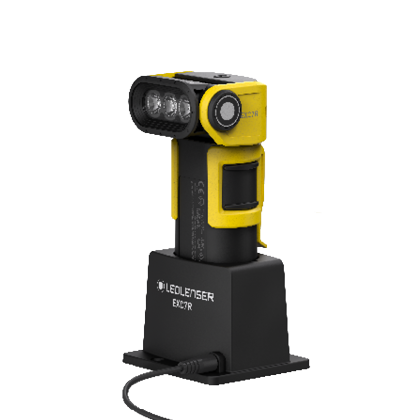
With the EXC6R and the EXC7R, Ledlenser offers two high-quality angle lights for firefighters. The dimensions of the EXC7R correspond to those of the typical angle lamps from other manufacturers. The EXC6R is more compact and lighter. Both angle lights meet the necessary requirements and can therefore be used anywhere. They are equipped with a replaceable, powerful rechargeable battery that can be charged via a charging station in the emergency vehicle. Two separate LEDs provide focused high beam light or homogeneous, glare-free working light at close range.
Both angle lamps have a swivel lamp head. By swiveling the lamp head upwards, the angle lamp can also be used as a hand lamp. If the light is worn on the chest, the area in front of the feet can be illuminated by swiveling it downwards without dazzling the other person. Thanks to IP68, they are very well protected against dust and water.
Hand lamps or LED flashlights
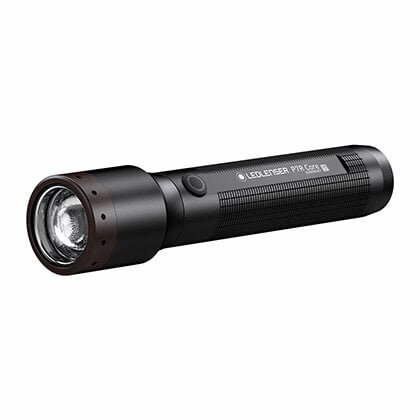
In addition to angle lights, firefighters also use hand torches. LED flashlights are the handy solution for directing the light beam precisely to where an area needs to be illuminated. However, they are not only used as hand lamps, but are also worn on the side of the helmet with the appropriate attachment.
In addition to explosion-proof flashlights, other high-quality flashlights are also used by the fire department, for example by the police or emergency services in the Search & Rescue sector.
Suitable flashlights have the following advantages:
- Thanks to LED technology, a fire department flashlight generates enormous brightness with low energy consumption. Firefighters therefore benefit from a long battery life, ideal for operations lasting several hours.
- Firefighter flashlights are generally so robust that they can withstand a fall without damage. They are also usually dustproof and waterproof. Ideal for withstanding the demanding conditions of firefighting operations and preventing damage during use.
- Depending on the model, some LED lights have several lighting modes, including various signal and flashing modes to improve communication and visibility, which is important for rescue operations during storms or flooding, for example.
ATEX-certified LED flashlights for firefighters from Ledlenser
Firefighters not only extinguish fires, they also actively prevent them, e.g. in potentially explosive areas where gas or dust can form a highly flammable mixture in the air. To prevent explosions in these so-called EX areas, only devices that comply with the standards of the ATEX directives of the European Union may be used there.
Ledlenser's EX series angle lights are certified accordingly and specially designed for use in these areas. As with all Ledlenser lamps, these models are also powerful and have been developed for use in hazardous situations. Equipped with a loop and a rotating clip, they can be easily attached to firefighting equipment, for example on bags or breathing protection.
The EX7 and EX7R flashlights and our EXH6R headlamp may also be used in potentially explosive atmospheres, but were actually developed for use in industry. The light pattern of the EX7 and EX7R does not comply with the standard for firefighting lights and both flashlight models are also slightly too large to be used as a helmet lamp. However, they are the only ATEX flashlights to feature the Advanced Focus System, which allows their light beam to be continuously focused. They can therefore still be very useful as a supplement.