

Emergency light: reliable lighting in the event of a power cut
Power cuts often occur without warning: due to bad weather, a technical fault or a simple short circuit. In such situations, every second counts. Without suitable emergency lighting, you are immediately plunged into darkness – a significant risk, particularly on staircases, in corridors or in cellars.
Having an emergency light in the event of a power cut allows you to keep your bearings, move around safely and continue with essential tasks without interruption. Whether at home, in the office or in business premises, a light that comes on during a power cut is part of the basic equipment – just like a fire extinguisher or a first-aid kit.
This guide explains how to choose an effective emergency light, which technologies to prioritise, what level of brightness to aim for – and which models are particularly recommended depending on your needs.
What should a reliable emergency light be capable of?
Before choosing a specific model, it is essential to understand the purpose of a home emergency light and what sets it apart from ordinary auxiliary lighting. Reliability, ease of use and the ability to provide immediate light are essential criteria when darkness falls without warning.
Definition and operating principle
An emergency light for power cuts is a light source designed to activate when the main power supply is cut off. Unlike conventional lights, it often incorporates a battery or an automatic power cut detection system. Its primary role is to provide minimal visibility, ensure safe movement and allow certain essential activities to continue.
These lights can be portable or fixed, LED or halogen, but in most cases, LED technology is now the norm due to its low energy consumption and extended lifespan. They are commonly found in corridors, stairwells, garages or business premises.
Automatic or manual switch-on?
Depending on the model, the light may switch on automatically – as soon as a power cut is detected – or require manual activation.
Automatic switch-on has the major advantage of reacting instantly without any intervention: the light comes on even if you are not there. This is the preferred solution for high-risk areas such as staircases or windowless rooms. On the other hand, a manual lamp offers greater flexibility, as it can be used as standard lighting on a daily basis and activated only when necessary.
The choice therefore depends on your environment and your priorities: maximum safety as soon as the power goes out, or versatile use in all circumstances.
Which technology should you choose for emergency lighting?
Not all emergency lights are created equal. The technology used directly affects the duration of illumination, light output and ease of maintenance. Today, most high-quality models rely on LED technology, combined with high-performance batteries or long-life cells. However, there are significant differences that are worth knowing before making a choice.
The advantages of LEDs
LED lamps have established themselves as the gold standard for emergency lighting, and this is no coincidence. They offer several major advantages: very low power consumption, a lifespan that often exceeds 20,000 hours, and instant light with no warm-up time.
In the event of a power cut, LED lighting guarantees full brightness from the very first second – a crucial factor in preventing panic or accidents. Furthermore, LED bulbs give off very little heat, which reduces risks during prolonged use and allows the light to be installed in a variety of environments.


Power source: battery, disposable battery or USB?
The power supply plays a key role in the practicality and reliability of your torch. Models that use disposable batteries offer a long runtime and the option to replace the batteries at any time. However, they require you to keep spare batteries in stock and generate more waste.
Rechargeable torches with a built-in battery (Li-Ion or NiMH) appeal for their simplicity: once charged, they remain ready for use for several months. Simply plug them in via USB or a mains adapter to top up the power. Hybrid models – compatible with both batteries and rechargeable batteries – combine these two advantages and guarantee maximum flexibility, particularly during prolonged use.
The choice therefore depends on your priorities: maximum battery life with disposable batteries, ease of use and cost-effectiveness with a rechargeable battery, or versatility with a combined system.
How many lumens are needed for effective lighting?
Light output is a key factor when it comes to emergency lighting. If it is too dim, the light makes it difficult to find your way; if it is too bright, it causes glare and consumes more energy than necessary. It is estimated that an emergency light should provide a minimum of 100 to 150 lumens to safely illuminate a small space such as a corridor or staircase.
For larger rooms, a garage or a work area, it is best to aim for between 300 and 500 lumens to achieve even and comfortable lighting. Some models offer several brightness levels, which can be activated manually or automatically, depending on the ambient light.
The key is to be able to adjust the brightness to suit the situation: a soft light is sufficient for moving around safely, whilst a stronger beam is useful for carrying out tasks or quickly identifying the source of a problem.
Where should you use an emergency lamp in the event of a power cut?
Emergency lamps for power cuts are not just for industrial buildings. They are useful anywhere where a power cut could pose a risk or simply make daily life more difficult. Priorities vary depending on the environment: ensuring safe movement, providing extended lighting, or ensuring visibility in key areas. Here are the main areas where having one makes a real difference.
In houses and flats
In a home, a power cut can quickly become uncomfortable, or even dangerous. A home emergency light placed in the living room, kitchen or hallway helps you find your way around and avoid falls. Compact models with wall brackets and automatic switches are ideal: they go unnoticed in everyday life, but are ready to work in an instant. For families, this provides essential peace of mind.


On staircases, in garages and cellars
Areas used for passage or storage are particularly prone to power cuts: a staircase plunged into darkness poses a major risk of falling. In a garage or cellar, it becomes difficult to locate circuit breakers or find your way out safely. A powerful lamp with a wide beam and a secure mounting – whether magnetic or wall-mounted – ensures immediate, even lighting, even when your hands are full.


In commercial premises and public access buildings
In a commercial environment (offices, workshops, shops) or a public access building (hotels, care homes, schools), an emergency light is often a legal requirement. It facilitates evacuation, helps prevent panic and ensures the continuity of critical operations. Models with automatic activation and extended battery life (>2 hours) are recommended to ensure the safety of employees and visitors in all circumstances.
Standards and quality criteria to be aware of
Not all emergency lights are created equal when it comes to safety and compliance. To be truly reliable, they must meet several standards and carry certifications that attest to their quality and durability. The CE mark guarantees that the product complies with European requirements for electrical safety and electromagnetic compatibility. The NF certification, which is more specific to the French market, attests to an independent assessment of the equipment’s reliability and performance.
Another crucial factor is the IP rating, which indicates resistance to dust and moisture. For use in a cellar or garage, a minimum IP54 rating is recommended. Finally, some lamps are designed to remain operational after an impact or a fall, which involves mechanical strength testing.
Before making your choice, always check for these certifications: they guarantee you a lamp that will work when you need it most.
Ledlenser torches for power cuts
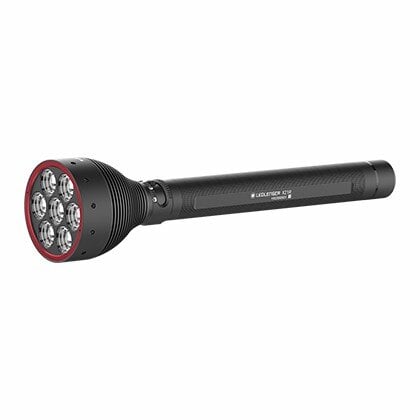
Ledlenser has always developed lighting solutions designed for critical situations: power cuts, technical operations or professional use. The brand’s torches stand out for their reliability, long battery life and robust design, capable of withstanding the demanding conditions of everyday life.
Thanks to advanced LED technology, they provide bright, even light as soon as they are switched on. Most models are fitted with rechargeable batteries and battery level indicators, so you always know how much power is left. Some portable torches can be converted into fixed light sources using a magnetic mount or a hook, making them particularly practical during a prolonged power cut.
Whether you’re looking for compact lighting for a flat or a more powerful solution for a business premises, Ledlenser torches combine power, simplicity and safety – so you can stay calm, even in complete darkness.
Emergency power cut lamp – Frequently asked questions and answers
A power-cut torch must have a clear charge indicator, sufficient battery life (at least several hours) and provide immediate light with no delay when switched on. CE certification and, if possible, NF certification guarantee that it complies with safety and reliability standards.
The runtime depends on the model and the selected lighting mode. On average, a high-quality LED lamp provides between 4 and 10 hours of light at medium brightness. Some models have an eco mode that extends the runtime to 20 hours or more.
Yes, most models can be used as a portable torch for everyday use. Simply switch them on manually when you need them. This versatility is ideal if you want a single device for both general lighting and emergencies.
For a small space, 100 to 200 lumens are generally sufficient to move around safely. For a garage, staircase or large room, opt for 300 to 500 lumens to ensure even and sufficiently bright lighting in the event of a prolonged power cut.
Battery-powered lamps offer long battery life and the ability to change the batteries at any time. Rechargeable models are more economical and environmentally friendly in the long run. If you’re looking for flexibility, opt for a hybrid lamp compatible with both options.