

How laser-excited phosphor works in LEP flashlights
A white beam of light visible from over 1,000 meters away: no LED, no xenon, but a laser that hits a tiny piece of phosphor and turns it into directional white light. What sounds like something out of a laboratory is already available in flashlights. In this article, you will learn exactly how LEP works and why this technology offers such extreme light ranges.
What is LEP?
LEP stands for Laser-Excited Phosphor. This is not simply a special type of LED, but a completely different concept of light generation that is physically distinct from the light generation of LEDs and other light sources.
While LEDs emit their brightness directly via a semiconductor chip, LEP uses a laser beam that hits a tiny phosphor plate. It is only there that the visible white light is produced. This allows for extremely precise beam guidance, with ranges of over a kilometer, even in compact devices such as a LEP flashlight.
How does LEP work?
LEP combines two things:
- A blue laser beam (typically with a wavelength of approximately 450 nanometers (nm)), generated by a semiconductor laser diode.
- A phosphor material that converts this beam into broadband white light.
Light generation process in LEP
1. The laser beam is focused. The optical system, consisting of two lenses, concentrates the light from the laser diode into an extremely narrow, almost parallel beam.
The aim is to concentrate as much energy as possible onto a tiny area – usually smaller than 0.2 mm².
This beam then hits a special luminescent material with high energy density: cerium-doped YAG. This stands for yttrium aluminum garnet, a synthetic single crystal or ceramic.
Cerium ions (Ce³⁺) are stored in it. These ions enable the subsequent light conversion process.
2. The phosphor absorbs part of the blue laser light. The light with a wavelength of approx. 450 nm energetically excites the electrons in the phosphor. When these electrons return to their ground state, they emit photons—albeit with lower energy.
This results in the emission of “new” light of a different wavelength. This light lies in the yellow spectral range, usually between 560 and 590 nm.
3. The emitted yellow light mixes with the unabsorbed blue component from the original laser beam.
Together, this creates an impression of white light to the human eye.
Important: This is not subtractive color mixing as in a paint box, but additive color mixing as in screens or monitors. There, for example, red + green = yellow. With the P9R Core LEP, blue + yellow = white.
In this case, blue + yellow (physically: a mixture of short- and long-wave components) produces a cool white that is perceived by the human eye as “neutral” or “daylight-like.”
The key factor is that the light emission occurs over an area of just a few tenths of a millimeter. This results in extremely high luminance, i.e., brightness per area. This point-shaped white light can then be concentrated with reflectors or lenses with virtually no loss.
The result is a very narrow, intensely focused beam of light with a long range and hardly any scattered light.
Difference between LEP and LED
LEDs generate light over a comparatively large area (e.g., 1–5 mm²). This means that the light is generated efficiently, but is less sharply focused. It is distributed in a relatively wide cone.
LEP, on the other hand, generates white light secondarily from an extremely small “spot.” This has several effects:
| Feature | LED | LEP |
| Light source | Direct beam | Laser + phosphor |
| Luminance | Medium | Very high |
| Focusability | Possible, but would require a comparatively large focusing lens | Extremely precise with a small focusing lens |
| Range | Approx. 200-500 m | Over 1.000 m possible |
| Beam angle | Narrow, with correspondingly large optics | Extremely narrow (spot), possible even with small optics |
In practice, this means that an LED flashlight is ideal for illuminating large areas up to medium distances. Thanks to our lens and focus systems, Ledlenser LED flashlights still achieve high lighting ranges of over 700 meters. A LEP lamp, on the other hand, specializes in pinpoint illumination at extremely long distances.
What is LEP particularly suitable for?
LEP is not a universal solution. But where selective lighting over long distances is required, this technology really comes into its own:
- Search and rescue: When people, reflectors, or landmarks need to be detected at distances of several hundred meters, e.g., in the mountains, on water, or in the forest.
- Tactical applications: Military, police, and security services use LEP lamps as “spotters” – to illuminate targets or send signals.
- Technology and maintenance: In industry, railways, energy supply, and construction, LEP can be used to perform spot visual inspections over long distances without on-site access.
- Light signals and visibility: LEP is also suitable as an optical marker or for remote communication via light signals, as the beam remains visible for kilometers.
Why and where does Ledlenser use LEP?
Ledlenser uses LEP technology specifically for applications where long range is crucial – not as a replacement for LED, but as a supplement.
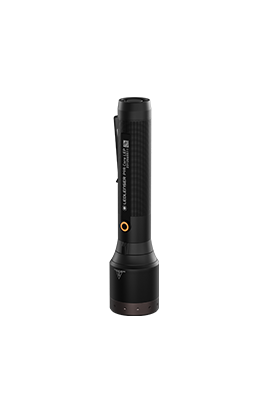
The LEP model P9R Core LEP is specially designed to deliver a concentrated, long-range beam of light. Nevertheless, this LEP laser flashlight can be adjusted to illuminate a wide area in the immediate vicinity. This more diffuse light is achieved by combining it with a COB LED.
LEP and LEP Flashlight – Frequently Asked Questions and Answers
LEP generates white light indirectly through a focused laser beam that hits a phosphor material. LEDs, on the other hand, emit light directly from a larger surface area. The result: LEP provides a much narrower, more precisely focused light source with a significantly greater range.
LEP light often appears colder and more concentrated, almost like a laser pointer with white light. The reason for this is the combination of a narrow blue component and converted yellow light. This results in a directional, high-contrast white light that differs greatly from the broader scattered light of classic LEDs.
The light itself is incoherent due to the phosphor conversion—in other words, it is no longer a “real” laser beam. Nevertheless, do not look directly into the beam and never shine it directly at people or animals. Although the light output is classified as eye-safe (Class 2), the high intensity in a confined space can cause severe glare or irritation.
Because the light source is extremely small, often less than 0.2 mm². This allows the light to be physically focused much more sharply than with LEDs. This is not a question of optics, but a consequence of the high luminance of the LEP system.
LEP is designed for distance, not necessarily for area illumination. LEDs are often more suitable for close-range or wide light cones. In addition, LEP modules are more complex in design and require precise optics and good cooling.
The main advantage is its enormous range despite its compact dimensions. LEP enables pinpoint lighting over hundreds of meters – with a clarity that LEDs cannot physically achieve. This is particularly useful for search, target detection, or signaling.
Whenever maximum range or precise illumination is required: long-distance searches, tactical operations, optical signals, or remote technical inspections. LEP is oversized for forest walks or campsite lighting, however.
Good LEP systems achieve several tens of thousands of operating hours – comparable to high-quality LEDs. Energy efficiency is slightly below LED levels, but the light output is concentrated on a tiny area – which is crucial for many applications.