
Key facts about the CRI in brief
- The CRI (Colour Rendering Index) measures, on a scale of 0 to 100, how faithfully a light source renders colours compared to a reference.
- A CRI of 80 is considered the standard for living and working spaces. A CRI of 90 or above is suitable for professional work where colour accuracy is important, such as crafts, medicine or photography.
- The CRI describes only the colour fidelity of a light source and is independent of colour temperature (Kelvin) and luminous flux (lumens).
What does the CRI value mean in relation to light?
The Colour Rendering Index (CRI), also known as the Ra value, describes how faithfully a light source renders colours compared to a reference light source that simulates daylight. It is expressed on a scale of 0 to 100, with 100 corresponding to perfect colour rendering, as achieved, for example, by incandescent bulbs or daylight.
How is the CRI calculated?
The CRI is calculated by comparing the colour rendering of a light source with eight defined test colours (R1 to R8) and taking the average of these values. A reference light source is used for comparison: Below 5,000 Kelvin, incandescent light is used for comparison; above 5,000 Kelvin, a daylight spectrum is used. The result is the figure usually stated on lamps.
- For the official CRI, eight pastel colours (R1–R8) are used, and the results are averaged.
- Saturated red tones (R9) are not taken into account in this process, but are important for skin tones, blood, food or red cables.
- Extended methods use up to 14 test colours, including skin tones (R13, R15), to provide more realistic values.
Example of the same CRI with different red rendering:
Two lamps with a CRI of 80 can look very different if one has a high R9 value and the other a low one.
A lamp with a CRI of 80 and R9 = 0 makes skin look sallow and red cables appear dull.
A lamp with a CRI of 80 and R9 = 60 looks significantly more natural, even with the same specifications.
What is a good CRI value for LED lamps?
A CRI of at least 80 is considered standard for workplaces, homes and communal areas such as break rooms or hotel lobbies. A CRI of over 90 is recommended for medicine, photography, quality control, paint shops and other areas where accurate colour rendering is of great importance. These thresholds are enshrined in standards such as EN 12464-1 for workplace lighting.
| Application | Recommended CRI | Special features |
| Office and living spaces | ≥ 80 | Standard according to EN 12464-1 |
| Workshops, trades, inspection | ≥ 90 | R9 important for cable and material colours |
| Medical fields | ≥ 90 | Accurate colour recognition for skin and tissue |
| Photography & Film | ≥ 90 | R9/R13 important for skin tones |
| Art & Museums | ≥ 90 | Detail and colour fidelity for exponents |
How does CRI differ from colour temperature and brightness?
The CRI describes exclusively the colour rendering quality of a light source and has no direct connection with colour temperature (Kelvin) or luminous flux (lumens). A lamp can therefore have a high CRI, regardless of whether it emits warm white or cool white light and how bright it is.
CRI and Kelvin measure different properties, but when determining the CRI, the light source is always compared with a reference of the same colour temperature: below 5000 K with incandescent light, and from 5000 K upwards with a daylight spectrum.
- CRI (Colour Rendering Index): A measure of true-to-life colour rendering compared to a reference.
- Colour temperature (Kelvin): Determines whether the light appears warm white (e.g. 2700 K) or cool white (e.g. 6000 K).
- Luminous flux (lumens), referred to as “brightness”: Indicates the total amount of light emitted.
Example:
An LED lamp with a colour temperature of 4000 K and a CRI of 90 can reproduce colours more realistically than a lamp with a colour temperature of 6000 K and a CRI of 70, even though the latter appears subjectively ‘whiter’.
What are the limitations of the CRI?
The CRI has limitations because it is based on only eight defined test colours and therefore does not realistically assess all colour nuances. A lamp can therefore have a high CRI even though important colours such as deep red are rendered poorly.
- Only R1 to R8 are taken into account: These pastel colours do not fully reflect reality.
- R9 is missing: Saturated red is not included in the basic calculation, but is important for skin tones, blood or cable markings.
- Deceptively high values: Two light sources with a CRI of 80 can appear very different, depending on their R9 rendering.
- No indication of saturation: The CRI only assesses the accuracy of colour rendering, not whether colours appear more vivid or duller.
What are the alternatives to CRI?
The TM-30 and TLCI methods have emerged as alternatives to CRI, offering a more nuanced and practical assessment of colours. These indices take into account a significantly larger number of colour samples and provide more accurate information on light quality.
TM-30 from the Illuminating Engineering Society, USA
TM-30 is primarily used in the lighting industry, research and standardisation work because, with 99 test colours, it provides a much more nuanced assessment. It offers reliable additional information for architects, lighting designers and industrial developers.
- Uses 99 test colours instead of just eight.
- Key figures: Rf (Fidelity = colour accuracy) and Rg (Gamut = colour saturation).
- Provides diagrams showing whether colours appear more natural, more saturated or paler.
TLCI (Television Lighting Consistency Index):
TLCI is specifically tailored to film, television and broadcast and has replaced CRI in these fields in recent years. It shows how cameras ‘see’ colours, not how the human eye perceives them.
- Developed for film and television productions.
- Evaluates how a camera perceives colours under a light source.
- Useful when it comes to skin tones or accurate colour reproduction in footage.
CRI remains the standard for everyday and workplace lighting
- In standards such as EN 12464-1 (Lighting of workplaces), a CRI of ≥ 80 is still specified as the minimum standard.
- Residential lighting: Consumers and manufacturers work almost exclusively with CRI values because they are easy to understand and established worldwide.
- Product data sheets & packaging: Manufacturers specify the CRI as standard; TM-30 or TLCI are only found in specific segments.
LED torches with high CRI from Ledlenser
Our Work series torches are designed for daily and intensive use. The models with a very high CRI of over 90 are ideal if your work requires accurate colour rendering: wiring, colour nuances in the automotive sector and expert reports, electronics and circuit board testing, painting and varnishing work, textile and fabric testing in fashion and design, quality control in industry such as for coatings, and much more.

P6R Work torch
The outstanding IP68 dust and water protection rating, extensive protective features and the lamp’s chemical resistance ensure extreme robustness and durability. In addition, the P6R Work emits neutral white light (4000 Kelvin) and offers particularly natural colour rendering.
- CRI 90
- Luminous flux: up to 850 lumens
- Beam distance: up to 230 metres
- Run time: up to 45 hours in the lowest mode
- Charging time: 225 minutes
- Water resistance: IP68

P7R Work Torch
Water and dust are no match for the P7R Work (IP68). Its protective features ensure that even impacts are easily absorbed. And finally, the material of the casing proves to be resistant to chemicals. But the P7R Work’s internal specifications are just as impressive. Extreme light output, a CRI of 90 for particularly natural colour rendering, customisable lighting functions, the practical magnetic charging system and a diffused white auxiliary light are just some of the features available alongside our patented Advanced Focus System.
- CRI 90
- Luminous flux: up to 1,200 lumens
- Beam distance: up to 240 metres
- Run time: up to 60 hours in the lowest mode
- Charging time: 270 minutes
- Water resistance: IP68
P7R Work UV Torch
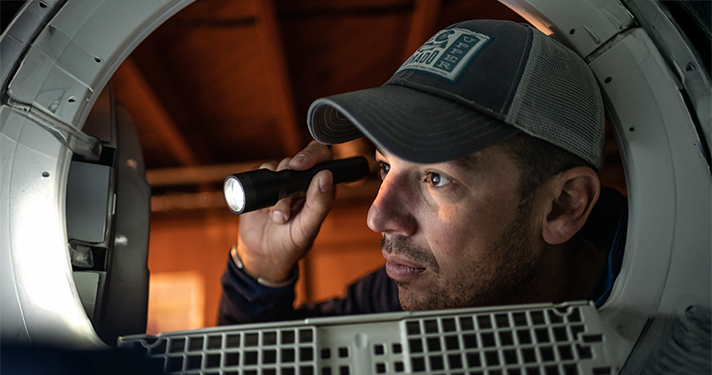
In addition to its powerful light output and a CRI of 90 for particularly natural colour rendering, the torch features a high-contrast UV light on the side of the body, which can be used, for example, to verify the authenticity of documents or to detect liquids.
- CRI 90
- Luminous flux: up to 1,200 lumens
- Beam distance: up to 240 metres
- Run time: up to 60 hours in the lowest mode
- Charging time: 270 minutes
- Water resistance: IP68

H7R Work Headlamp
The intuitive H7R Work provides the perfect light for working: bright, consistent, neutral white and flicker-free. The high CRI value of 90 ensures natural colour rendering. The headlamp also offers comprehensive protection against dust, water and impacts, and comes with a comprehensive range of accessories. The H7R Work is infinitely dimmable and the beam can be infinitely focused thanks to the patented Advanced Focus System.
- CRI 90
- Luminous flux: up to 1,000 lumens
- Beam range: up to 250 metres
- Run time: up to 60 hours in the lowest mode
- Charging time: 210 minutes
- Water resistance: IP67

H15R Work Headlamp
The H15R Work is the workhorse of headlamps. It combines extreme brightness, stepless focusing and maximum robustness. It offers constant, neutral white, flicker-free light with high colour rendering, stepless dimming, extreme shock, dust and water resistance, microbe-resistant material and a comprehensive range of accessories. Everything about the H15R Work is designed to provide professionals with the best possible light whilst they work.
- CRI 90
- Luminous flux: up to 2,500 lumens
- Beam distance: up to 250 metres
- Run time: up to 70 hours in the lowest mode
- Charging time: 330 minutes
- Water and dust resistance: IP67